


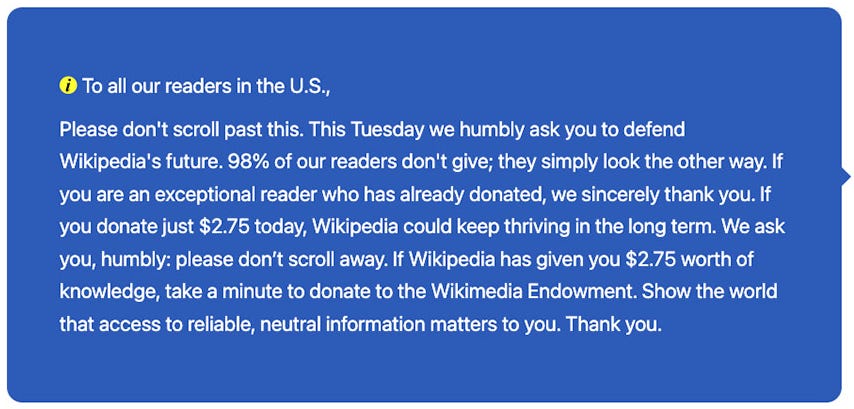
Wikipedia wants your money.
In fact, every year — without fail — the Foundation plasters the top of its pages with guilt-inducing banners implying the site is seconds away from collapse if you don’t chip in five dollars.
Meanwhile, behind the curtain?
The world’s “free encyclopedia” is waging an invisible war against the very people who build culture — artists, authors, musicians, filmmakers, journalists, historians, and creators of every kind.
Call it what it is:
Wikipedia has become the most hostile environment on the internet for the people who produce the knowledge and cultural output the site pretends to celebrate.
And the irony is blinding:
Creators are punished for contributing
Volunteers with no accountability control everything
Donors fund an organization that outsources nearly all labor to unpaid gatekeepers
And contributors are routinely attacked by the same editors the Foundation refuses to regulate
This isn’t a “bad apple” problem. It’s a systemic, cultural failure — one that has gone unchecked for 20 years.
The Great Wikipedia Paradox - Creators make the content, but volunteers control the narrative.
On paper, Wikipedia’s mission is noble:
“Gather the sum of all human knowledge.”
But in practice?
The platform operates like a closed guild, policed by entrenched volunteers who often:
distrust creators
resent subject-matter experts
assume bad faith
and wield policy like a blunt weapon
Creators who attempt to correct misinformation or add missing history are met with:
“COI” accusations
“PAID” accusations
“AI-generated” accusations
bureaucratic obstruction
hostility
mockery
and sometimes, permanent bans
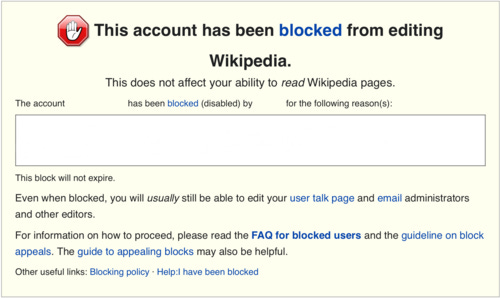
These attacks are not isolated. They are routine. Predictable. Documented across hundreds of discussions, forums, and editor complaints.
Creators are treated not as contributors — but as potential threats.
And it gets worse.
Why Wikipedia Distrusts Creators - The platform is built on a fundamental contradiction.
Wikipedia’s ideology assumes:
Anyone with firsthand knowledge is automatically biased.
But
Anyone with no knowledge is inherently neutral.
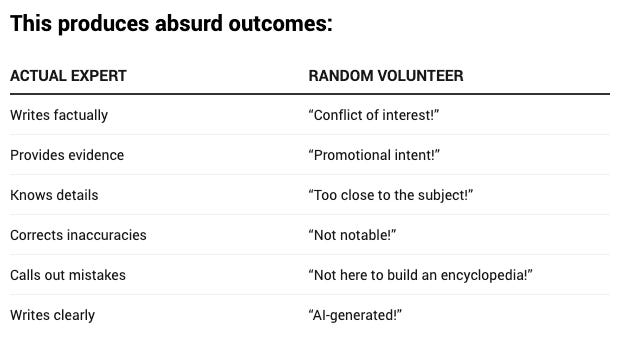
This is how Wikipedia ends up in the bizarre position of:
rejecting factual content
erasing legitimate history
punishing subject-matter experts
deleting pages about pre-internet works
dismissing physical archives
promoting digital bias
rewarding ignorance
empowering hostility
and ostracizing the creators whose work built the culture the site depends on
Creators aren’t just mistrusted. They are penalized for knowing too much.
Volunteers are empowered for knowing nothing.
This is how Wikipedia loses history — and why creators learn quickly:
You are welcome to read Wikipedia.
But you are not welcome to contribute.
The Violence of Volunteerism - Where is the money actually going?
Now for the part Wikipedia really doesn’t want discussed.
Every year, the Wikimedia Foundation raises $150–$180 million in global donations.
What do donors think they’re funding?
Fact-checkers
Editors
Moderators
People who improve articles
People who prevent abuse
What does the Foundation actually fund?
✔ Lawyers
✔ Lobbyists
✔ PR
✔ Branding
✔ Staff not involved in content
✔ Grants for unrelated projects
✔ Executive salaries
✔ Administrative overhead
What do they fund the least?
❌ Actual moderation
❌ Editor training
❌ Editorial staff
❌ Trust & safety intervention
❌ Cleanup of abusive behavior
❌ Accountability systems
❌ Support for creators
❌ Historical preservation
Who does the real editorial labor?
Unpaid volunteers
— many of whom:
never worked professionally in research, journalism, or culture
have no editorial oversight
enforce policies inconsistently
bully newcomers
engage in dogpiles
and operate without transparency or accountability
Worse:
Wikipedia’s paid Foundation staff have no authority to regulate the volunteer editors who run the site.
So:
Volunteers attack contributors
Contributors leave
Articles remain inaccurate
Donors assume their money hired people to prevent this
And Wikipedia continues begging for cash
The dysfunction is breathtaking.
The AI Paranoia Crisis - A new weapon for old gatekeepers
In the past year, a disturbing new trend has emerged:
Veteran editors now dismiss articulate writing as “AI-generated.”
It is the perfect smear because:
it requires no evidence
it delegitimizes instantly
it shuts down debate
it cannot be disproven
it polices style instead of substance
it gives veteran editors a pretext to block anyone
What used to be:
“You’re too close to the subject” has evolved into:
“You write too well — therefore you’re not human.”
It is:
the new witch hunt
the new “paid editor” smear
the new way to silence outsiders
the new power move for gatekeepers
AI paranoia has become the perfect excuse to block anyone they dislike.
The Real Victims - Creators of Pre-Digital History
The people most harmed by Wikipedia’s hostility are not spammers or marketers.
The people hit hardest by Wikipedia’s hostility are:
Independent creators
Analog-era artists
Journalists from the print era
Regional broadcasters
Local historians
Community documentarians
Anyone whose work predates Google
Wikipedia’s notability system — created after the digital revolution — cannot meaningfully evaluate culture that existed before the digital revolution. Anyone whose work existed before Google is treated as fiction.
And instead of updating the system, Wikipedia punishes those who try to bridge the gap.
It has erased:
local arts movements
independent film scenes
regional culture
early-career milestones
community histories
pre-internet journalism
analog broadcasts
grassroots creative ecosystems
Not because they lack cultural value — but because they lack digitized evidence. This produces a massive, ongoing erasure of entire cultural ecosystems.
Wikipedia routinely dismisses:
physical archives
newspaper listings
institutional catalogs
microfilm
broadcast ephemera
exhibition histories
early academic work
regional achievements
foundational innovations
analog media history
Not for lack of relevance.
But because the evidence isn’t readable by Google.
This is how Wikipedia becomes the web’s most powerful force for unintentional cultural erasure.
The Reddit Meltdown That Proved The Point - When gatekeepers leave their home turf, the behavior goes with them
Shortly after publishing Part II, a link shared on r/Wikipedia triggered a meltdown so predictable and so on-brand that it deserves documentation.
One user — immediately and aggressively — responded with:
accusations of being an AI
accusations of being a paid editor
tone-policing
identity-policing
conspiracy theories
hostility toward articulate writing
wild assumptions about intent
demands for personal disclosure
attempts to “unmask” the author
claims that criticism of Wikipedia is evidence of wrongdoing
It took two comments before the moderator locked the thread:
“Since this post is going to draw more heat than light, I’m locking this thread.”
The incident was not a distraction — it was data.
It demonstrated:
the same hostility
the same pack behavior
the same refusal to engage ideas
the same identity fixation
the same weaponization of suspicion
the same anti-creator bias
Wikipedia’s culture doesn’t stay on Wikipedia. It spreads into every space its defenders occupy.
Wikipedia Will Not Fix Itself - Because the Foundation benefits from the dysfunction.
Wikipedia thrives on a myth:
“We’re a nonprofit.
We’re broke.
We need your help.”
Meanwhile, the Foundation is sitting on hundreds of millions in assets, and the people making the site unbearable? They’re unpaid, unregulated, and unmonitored.
It’s the digital equivalent of:
volunteers patrolling a library
using hostility to keep people out
while the librarians keep asking for donations
to fix a problem the volunteers created
The Foundation gets the money. The volunteers get the power. The creators get the abuse.
It’s a perfect system — for everyone except the public.
What Comes Next - The Platform Accountability Files
This article is Part III in our ongoing investigative series into platforms that:
weaponize their users
enable abuse
distort truth
and hide behind “community standards”
Upcoming installments include:
YouTube
“Three Strikes for Thee, Never for Me: How YouTube Enables Abuse by Protecting Repeat Offenders”
GoFundMe
“Crowdfunding or Laundering? The Dark Architecture Behind GoFundMe’s Moderation Failure”
Meta / Facebook
“Shadowbans, Fraud Ads, and Community Collapse: Why Meta Cannot Police Itself”
Reddit
“The Tyranny of Volunteer Mods: How Reddit Outsourced Governance to Unaccountable Mini-Dictators”
The Broader Crisis
“How Tech Platforms Became Unaccountable Institutions That No Longer Serve the Public”
Each installment will:
expose platform failures
examine real cases
document systemic abuse
reveal financial incentives
call out hypocrisy
propose reforms
The Platform Accountability Files — YouTube “Three Strikes for Thee, Never for Me: How YouTube Enables Abuse by Protecting Repeat Offenders” — coming next.
Stay tuned.