


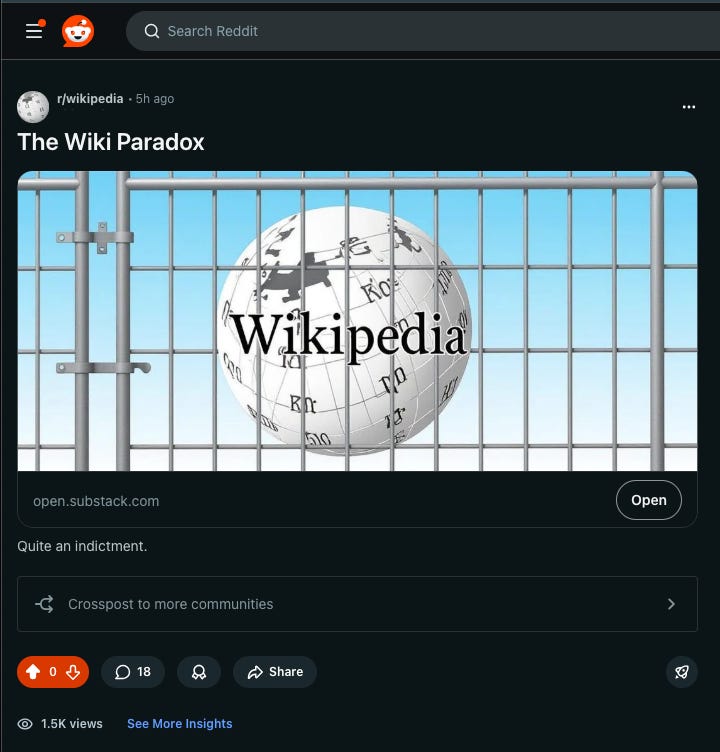
(UPDATE: Not long after this article went live, something happened that perfectly illustrated the culture I describe below.
I shared the link in r/Wikipedia — a subreddit that should be able to discuss criticism of the platform on its merits. Instead, the reaction unfolded with such speed, hostility, and predictability that it deserves to be documented here.
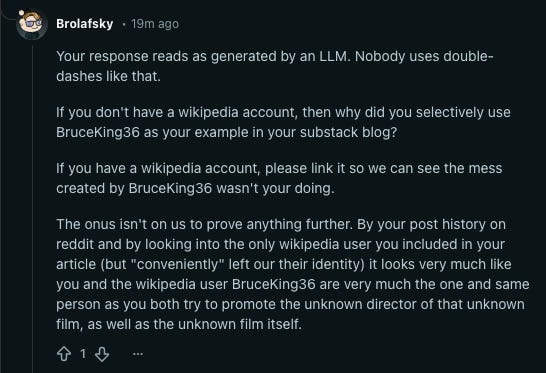
Within minutes, the top response came from a user who accused the article of being:
written by the person behind a specific Wikipedia account
“self-promotional” (without evidence)
generated by an AI because it was “too articulate”
part of a conspiracy to “promote” individuals the article didn’t even name
None of these claims referenced a single policy, fact, or argument made in the piece. Instead, the reaction consisted entirely of:
identity-policing (“Tell us who you really are”)
tone-policing (“Nobody writes like this”)
accusations based on unrelated Reddit activity
insults about the author’s intelligence, motives, and career
demands that I justify myself personally instead of the argument
It was the exact mindset this article critiques — playing out in real time, publicly, in front of moderators.
Here is what I said in response, with full transparency:
“Yeah yeah yeah.
Everything you don’t like that challenges your narrative becomes ‘LLM.’
Maybe some people are simply capable of writing clearly without resorting to attacks.
And if you had any real talent for writing, you wouldn’t be spending your time as an unpaid Wikipedia enforcer or Reddit gatekeeper.”
A few minutes later, a moderator stepped in and made a decision that said everything:
“Since this post is going to draw more heat than light, I’m locking this thread.”
The thread wasn’t locked because of me.
It was locked because the reaction confirmed every point the article makes:
the defensiveness
the hair-trigger hostility
the inability to separate critique from attack
the instinct to police people instead of ideas
the hive-like dogpiling
the eagerness to declare “AI!” when encountering articulate, structured writing
the refusal to engage with arguments, preferring instead to interrogate identity
The Reddit meltdown became Exhibit A — an unsolicited, unintentional demonstration of the very problem this article examines.
This update is not about drama.
It is about showing readers — with actual, real-time evidence — that the cultural dynamics described below are not hypothetical or exaggerated.
They are active. They are visible.
And the moment you critique Wikipedia’s internal culture, even off-platform, those behaviors surface instantly.
Sometimes the strongest evidence is what happens when the gatekeepers leave their home turf.
Full thread here:
https://www.reddit.com/r/wikipedia/comments/1paabc1/the_wiki_paradox/
When we published The Wiki Paradox — an examination of how Wikipedia gatekeeping disproportionately suppresses pre-internet history, independent creators, and non-corporate cultural memory — I expected debate.
What I didn’t expect was instant, synchronized backlash within seconds of posting the link on Reddit.
Not reasoned critique. Not disagreement. Not discussion.
Reflex.
A user responded within literal seconds — faster than the article could physically be read — with a pre-baked dismissal:
“I’m sorry but your article reads as ‘Wikipedia as explained by someone who’s never made an account, contributed, tried to learn or even edited anything…’ ”
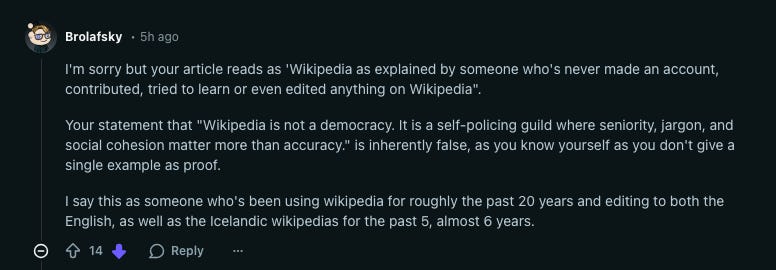
Impossible. The article was long, layered, and structured. The commenter hadn’t read it — because he didn’t need to.
He recognized the threat: A critique of Wikipedia culture.
And the hive responded on cue.
Within minutes, more comments followed, all carrying the same tone:
defensive indignation
projection
tone-policing
gaslighting (“This never happens.”)
credential flashing (“I’ve edited Wikipedia for 20 years…”)
false accusations
denial of obvious systemic patterns (“There is no gatekeeping.”)
The irony?
The article itself was a system-level analysis built on documented cases and patterns — many experienced firsthand — but the commenter didn’t read it. They reacted the moment the headline challenged their guild.
This reflexive behavior didn’t disprove the thesis. It confirmed it.
Introduction: What Happens When You Criticize the Hive
Wikipedia likes to call itself “the encyclopedia anyone can edit.” Reddit likes to call itself “the front page of the internet.” Together, they form something very different:
A self-validating ecosystem where a tiny, entrenched volunteer class polices public knowledge — and reacts with immediate hostility to any outsider who questions its authority.
Part I documented how impossible it has become to add legitimate, pre-internet history to Wikipedia. But what happened next revealed something deeper:
Not only is Wikipedia governed by an insular cadre of deletionist gatekeepers —
they swarm outside the platform too.
When Part I of this series was shared on Reddit’s r/Wikipedia, what followed was not disagreement, not debate, not dialogue.
It was instant dogpiling — within seconds.
Before anyone could have even read the article.
The reaction wasn’t merely defensive; it was reflexive, ritualistic, and performative.
It was the hive defending itself.
This is Part II — an analysis of what these reactions reveal.
🔥 Exhibit A: The Hive Reacts Before Reading
If a post receives a long rebuttal within seconds, that’s not “analysis.” That’s tribal defense.
It’s identical to:
downvote brigades
subreddits run by insiders
moderators who immediately side with entrenched editors
“I’ve edited here for 20 years” credential-waving
All of this is designed not to persuade — but to protect status hierarchy.
Reddit’s r/wikipedia community acts like a digital immune system: anything challenging the culture is treated as a threat.
🔥 Exhibit B: The Pattern Is Always the Same
Every critical post about Wikipedia triggers the same predictable responses:
1. Immediate denial of systemic issues
Without reading the piece, the claim was:
“Your statement is inherently false…”
This is the core tactic: Defend the institution first. Facts later. Maybe.
2. Authority-by-tenure
Every hive defender leans on the same credential:
“I’ve edited Wikipedia for X years…”
As if unpaid longevity equals infallibility. It signals group identity, not argument.
3. Gaslighting via pedantry
Rather than engaging with the thesis, they nitpick imagined errors to discredit the author.
4. Projection and character assassination
Every critique becomes a personal flaw.
5. The Purity Test: “You don’t understand how Wikipedia works.”
Translation: “You’re not in the guild.”
This is the exact behavior documented in academic studies of Reddit groupthink:
communities reinforce themselves by punishing dissent, not engaging with it.
The fact that they did it instantly only makes the point stronger.
🔥 Exhibit C: Why the Hive Reacts This Way
What happened on Reddit mirrors what happens inside Wikipedia itself:
The Reddit meltdown wasn’t random — it was predictable. Because Wikipedia has evolved into:
A cultural monoculture with the psychological profile of a closed guild.
When you examine hundreds of Reddit comments across similar threads, six traits reappear:
1. Territoriality
Editors internalize ownership over “how Wikipedia works.” Criticism feels like trespassing.
2. Identity Fusion
The editor’s identity fuses with the platform. Criticism of Wikipedia becomes criticism of them.
3. Hierarchical Conditioning
Years spent arguing policy minutiae creates a belief that outsiders must “earn their place.”
4. Ritualized Tribal Defense
Attacking critics signals loyalty to the group.
5. Purity Maintenance
Policing tone, style, and imagined “AI contamination” becomes a moral duty.
6. Collective Narcissism
When an institution is self-policing and unaccountable, fragility looks like righteousness.
This is what Part I called “the Wiki Paradox.” Reddit simply confirmed it live and in the wild.
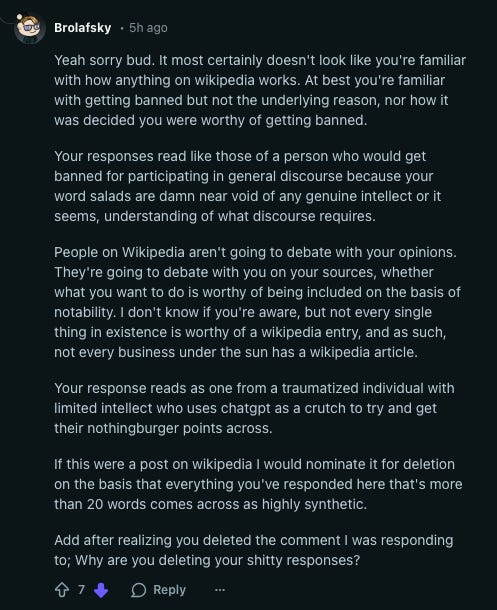
The pattern is so uniform it may as well be a flowchart.
And this isn’t happening in a vacuum — it’s happening on a platform that:
asks for millions in donations
has no paid editorial staff
is run entirely by unpaid volunteers
operates like a guild with no accountability
dictates what “counts” as human knowledge
Yet its defenders insist there is no hierarchy, no priesthood, no entrenched culture.
Then they behave exactly like one.
🔥 Exhibit D: The AI Panic as Weapon
This is the newest and ugliest tactic:
Any outsider who writes clearly or structurally is accused of using AI.
On Reddit.
On Wikipedia.
On talk pages.
On help desks.
On deletion discussions.
Everywhere.
A baseless accusation that functions as:
a credibility-killer,
a conversation stopper,
a justification for dismissal,
a cudgel to avoid engaging with arguments.
This is how the hive handles rhetoric it can’t control.
🔥 Exhibit E — The Reflexive “Not Here to Build an Encyclopedia” Attack
This is Wikipedia’s version of excommunication.
On Reddit, you see the same pattern:
“You don’t understand Wikipedia.”
“You’ve never contributed.”
“This is not accurate.”
“This sounds like someone who has never edited before.”
It’s the same line they use to silence any internal critic on-wiki.
The message is always the same:
“We decide who belongs here.”
🔥 What This Says About the Larger Rotten Structure
Part II demonstrates something Part I hinted at:
Wikipedia is not merely hard to contribute to.
It is hostile to being questioned at all.
Not because you’re wrong.
Not because your history lacks value.
Not because your sources are inadequate.
But because you are outside the social ecosystem that governs the site.
Reddit exposed the cultural root:
Wikipedia’s community has become its own ideology.
One that defends its hierarchy first, knowledge second.
If knowledge comes from outside their editorial caste?
It is treated as suspect, promotional, unworthy, delusional, or fabricated.
This is not how a public knowledge repository should operate.

🔥 And the Funniest Part?
The Reddit thread that tried to dunk on the article became the next article.
They handed over the evidence, tied with a ribbon, timestamped, and archived.
They don’t realize it yet — but they’re participating in a case study.
🔥 Postscript
When “Volunteer Editors” Become Online Harassers
After the Reddit dogpile, the behavior didn’t stop on the thread. Brolafsky’s stalking and harassment moved to private DMs — fast, obsessive, and increasingly hostile.
Below is the full sequence, presented exactly as received.
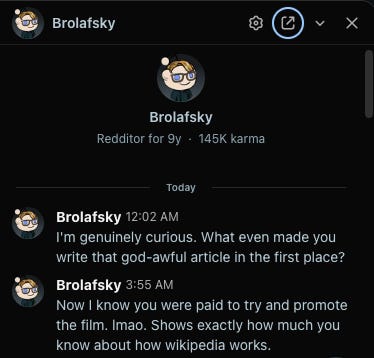
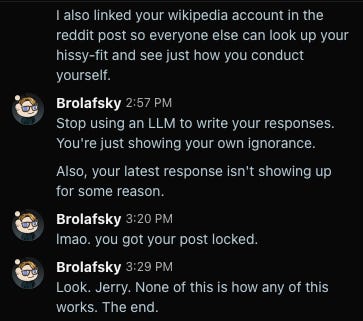
What This Shows (and why it matters)
This is not a debate. It is not an exchange of ideas. It is not “spirited disagreement.”
It is:
• unwanted contact
• repeated messages after no response
• late-night to all-day monitoring
• manufactured accusations
• attempts to provoke
• transparent retaliation for criticism of Wikipedia
• creepy fixation on identity
• continued escalation despite no engagement
And most importantly:
It is the exact same pattern creators experience inside Wikipedia — now spilling into other platforms.
The hostility isn’t confined to article talk pages.
It isn’t confined to ANI pile-ons.
It doesn’t stay “within the walls of the project.”
This culture follows people.
It harasses them off-platform. It tries to intimidate them into silence. It treats criticism of Wikipedia as a personal offense.
This behavior is not an exception. It is a symptom.
And it’s exactly why platforms built on unpaid gatekeepers collapse into abuse ecosystems.
When criticism of Wikipedia triggers this level of personal obsession, it tells you everything you need to know about the culture behind the curtain.
And why it’s long past time for sunlight.
💣 Update — Reddit Just Suspended One of the Wikipedia Defenders
Shortly after publishing this article, something remarkable happened.
One of the most aggressive Wikipedia defenders — the Reddit user u/Brolafsky, who had been spamming hostile replies, stalking my post history, and sending repeated harassing DMs — has now been silently removed from the platform.
Within minutes of filing a report with Reddit Safety: his 9-year account history evaporated, his 145,000+ karma vanished, and his profile was reduced to an empty shell.
For clarity:
This is what Reddit accounts look like when Reddit Admins (not subreddit mods) suspend a user for harassment.
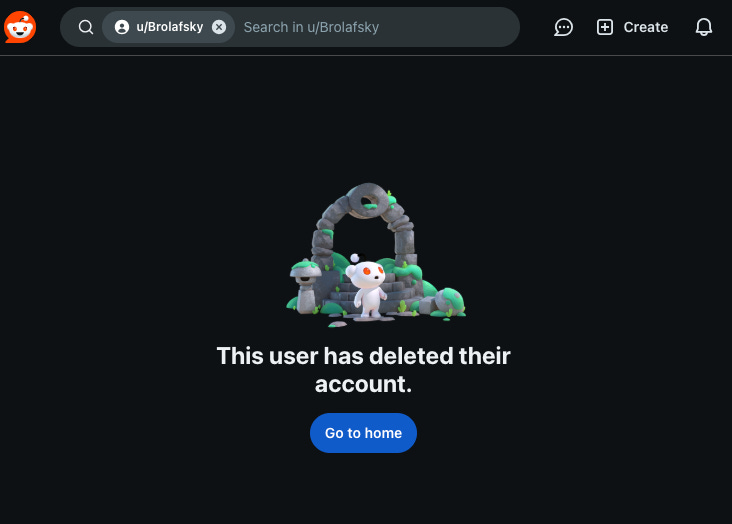
Reddit does NOT show when admins remove an account — it ALWAYS displays “user deleted their account” — it’s by design.
When Reddit bans or admin-removes an account, they intentionally mask it as:
“This user has deleted their account.”
They do this for:
privacy
to avoid retaliatory harassment
legal reasons
So you CANNOT tell the difference by the profile page alone.
You can’t fake this.
You can’t hide it.
And you can’t undo it.
This is the same user who: messaged me multiple times overnight, attempted to “out” my real identity, followed me across threads, accused me of running an “LLM conspiracy,” and posted about me obsessively before his account was nuked.
Then, suddenly — gone.
This is not about one troll getting removed. This is about a pattern:
The exact same gatekeeping culture that poisons Wikipedia spills onto every platform these people touch.
It is: the same hostility, the same dogpiling, the same suspicion of creators, the same fixation on hierarchy, the same contempt for anyone outside their inner circle.
When confronted with criticism of Wikipedia’s culture, these users didn’t debate the facts or challenge the argument.
They: went personal, went obsessive, went accusatory, and ultimately violated platform rules hard enough to get themselves erased.
If anything, their reaction proved the article’s thesis more effectively than the article itself:
Wikipedia’s volunteer gatekeeping culture is no longer confined to Wikipedia. It has metastasized into an identity — one that travels with its most zealous defenders wherever they go.
And sometimes, platforms with actual safety teams respond the way Wikipedia refuses to:
By removing the problem.
📌 Closing: The Ecosystem Has No Accountability — Yet Controls the World’s Knowledge
This incident isn’t a one-off. It’s the opening chapter of a much wider series examining:
Wikipedia’s culture
the gatekeeping behavior
the erosion of pre-internet history
the suppression of everyday creators
the paradox of an “open encyclopedia” run by a closed, aggressively territorial subculture
Part II shows the hive outside its walls. Part III will document its internal failures:
the deletionist culture
the contradictory sourcing rules
the weaponized jargon
the structural vulnerability to bullying
the lack of staff oversight
the absence of accountability
and the slow decay of pre-internet history under its rule.
This is not the end of the story. It’s the beginning of The Platform Accountability Files.
Part III — “Wikipedia’s War on Creators” — coming next.
Stay tuned.