


Wikipedia is treated as the internet’s universal memory — the modern Library of Alexandria we’re told “anyone can edit.”
But behind the slogan lies a far more insidious truth:
Wikipedia has become one of the most effective cultural erasers of the pre-digital era — and one of the most hostile environments for anyone trying to correct the record.
This is not an accident. It’s the result of structural bias, outdated policy, and a volunteer culture that has grown increasingly territorial, insular, and suspicious of the very people who carry firsthand knowledge.
The platform that claims to safeguard the sum of human knowledge is actively erasing large swaths of it — particularly the history that predates the internet.
And when contributors attempt to add that history?
They often face ridicule, smear tactics, dogpiles, and permanent bans.
This is not an isolated phenomenon. It is Wikipedia’s status quo.
Why Creatives, Archivists, and Historians Are Walking Away
Every year Wikipedia sends out its familiar banner:
“Please donate. We depend on readers like you.”
But anyone who has actually tried to contribute legitimate historical information knows the truth:
Wikipedia isn’t struggling because the world refuses to donate. It’s struggling because the platform has driven away the very people capable of strengthening it — creators, researchers, archivists, and primary participants in history.
For all the talk about “open knowledge,” the site has quietly evolved into a maze of:
volunteer gatekeepers,
inconsistent policy enforcement,
hostility toward newcomers,
and an unwritten culture that treats ordinary contributors as intruders.
Through a combination of burnout, ego, and entrenched cliques, Wikipedia has made one thing clear:
Its editors are no longer curating history — they are policing it.
And they’re doing it with rules optimized for the digital era that erase everything that came before it.
The Core Problem
Wikipedia Was Built by and for the Digital Era — Not the Real One
Wikipedia launched in 2001. By then, the internet had already begun erasing decades of cultural memory. The majority of human history — creative, political, cultural, technological — occurred long before online journalism existed.
Most newspapers from the 70s, 80s, and 90s weren’t digitized. Local journalism was offline. Television logs existed only in print. Community arts, independent media, regional broadcasts — none of it lived on the web.
But Wikipedia’s verification model assumes if something is:
too old to have online reviews,
too niche for national digital press,
too regional to appear in modern searchable databases,
preserved only in libraries or archives,
or documented in print before the web era…
…it is treated as inherently suspicious.
This has catastrophic implications.
Pre-digital history becomes invisible
Independent creators are excluded
Regional culture disappears
Community archives become worthless
Analog documentation is dismissed
Firsthand experience is treated as a conflict of interest
Offline primary evidence is rejected outright
This creates a structural nightmare: the older and more historically significant a subject is, the harder it is to prove its existence to Wikipedia.
That’s the core paradox:
If a piece of history is old enough to matter, it’s too old to verify under Wikipedia’s rules.
And anyone who tries to fix this runs headfirst into the wall.
The Culture Problem
A Volunteer Aristocracy Controlling the Gates
Wikipedia’s fatal flaw is not its technology — it’s its people.
Over two decades, the site has developed a rigid caste system:
Veteran editors wield enormous informal power
Newcomers are treated with suspicion
Experts are accused of “conflict of interest”
Creators are assumed to be promoters
Clear writing is dismissed as “AI-generated”
Policy becomes a weapon, not a guide
Dogpiling is normalized
Dissent is punished
Wikipedia is not a democracy. It is a self-policing guild where seniority, jargon, and social cohesion matter more than accuracy.
And nowhere is this more visible than when someone tries to add pre-digital cultural history.
Because nothing triggers Wikipedia’s gatekeepers more than offline evidence —
or the idea that a knowledgeable person might contribute an article about something they actually lived through.
The Fate of Anyone Who Tries to Add Pre-Internet History
A contributor attempts to add culturally relevant history from decades ago — a piece of offline, analog-era culture with:
real documentation in print sources,
verifiable archival material,
legitimate historical context,
and a clear role in regional or national culture.
The subject could be:
a local arts program,
an early community publication,
a regional broadcast project,
an independent creative work,
a thesis or invention housed in university archives,
or a foundational contribution overshadowed by later developments.
It does not matter.
Wikipedia treats pre-internet history the same across the board:
“Not notable.”
“Unverifiable.”
“Suspicious.”
“Promotional.”
Even when evidence exists.
Offline archives and primary documentation — hallmarks of real historical work — are dismissed outright.
Meanwhile, ephemeral digital fluff with a single blog mention sails right through.
This isn’t a coincidence.
This is a structural flaw in Wikipedia’s DNA.
The Gatekeepers: A Culture of “No”.
For many newcomers, the shock isn’t the decline — it’s the behavior.
In one Representative Case, a contributor followed every rule:
disclosed their connection
submitted through Articles for Creation (AfC)
used proper sourcing formats
cited scanned newspapers and print materials
asked respectful questions
sought clarification on guidelines
And then the machine kicked in.
Reviewers applied the wrong guideline. When the contributor pointed this out — politely — they were shouted down.
Veteran editors descended in a classic dogpile. Not to discuss policy. To assert dominance.
Offline documentation was dismissed outright, Because Wikipedia’s culture no longer understands how pre-digital sources work.
The contributor was accused of ulterior motives. Without evidence. Without justification. Without restraint.
Clear writing was declared “AI-generated”. A new, lazy smear tactic used to delegitimize articulate newcomers.
The contributor was told to “stop editing”. Veterans policing newcomers like unruly children — a recurring theme.
When the user requested help through the correct venue?. They were reprimanded again.
And ultimately, they were banned. Not for breaking rules — but for challenging the people who misapplied them.
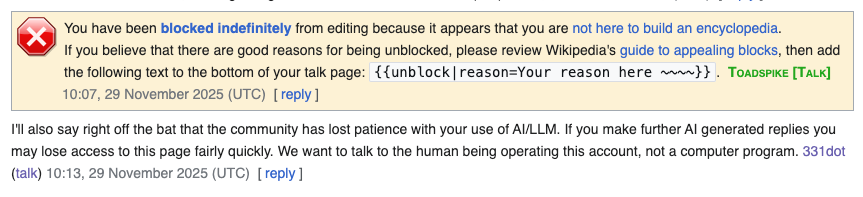

This case did not go wrong. It went exactly the way Wikipedia’s culture is structured to operate. These interactions often occur before your content is even evaluated.
It’s the Wikipedia equivalent of:
“Don’t question the elders, this is our turf.”
This isn’t knowledge stewardship. This is a social hierarchy masquerading as public service.
When “Notability” Becomes a Weapon
Every system reveals its true nature when challenged.
And on Wikipedia, the reaction to even the mildest correction — even the smallest attempt to document real pre-internet history — can be fierce, personal, and deeply revealing of the culture behind the curtains.
In one widely observed example, a contributor attempted to add a verified pre-internet work to the encyclopedia: something with real broadcast history, real archival evidence, and a legitimate place in cultural context.
The issue at hand should have been simple:
Does the history check out?
Do the sources verify the broadcast or publication?
Is the content appropriate under the subject-specific guideline?
Instead, the response from an administrator became a case study in exactly the problem this article describes.
Rather than address the underlying content, the admin framed the attempt to document verified history as:
promotional,
suspicious,
incompetent,
and somehow deceptive.
The contributor disclosed their conflict-of-interest exactly as policy required.
They openly stated their role in the history they were documenting.
They provided evidence.
They asked for guidance.
They tried to follow the process.
But the platform’s gatekeepers did not treat this as transparency —
they treated it as a threat.
Wikipedia has an unwritten rule that creators, inventors, public participants, and primary witnesses are inherently suspect. Their expertise is treated not as valuable, but as promotional by definition.
This is how history disappears: When the people who lived it are told they’re not allowed to speak.
Below is an excerpt of an administrator’s public justification for blocking the contributor. Read it carefully, because it illustrates the exact dynamics this series is exploring — the way Wikipedia uses tone policing, motive speculation, and personal discrediting to maintain control over historical narratives.

The Anatomy of a Smear Disguised as Moderation
Every sentence of the administrator’s statement carries an assumption — none of which are grounded in policy:
1. “Promotional editing”
= Any attempt by a creator to document their own verifiable history.**
This is exactly how Wikipedia erases creators, archivists, inventors, and early digital pioneers.
**2. “Serious competence issues related to LLM use”
= A modern version of “You don’t belong here.”**
Wikipedia has no policy prohibiting drafting with an AI tool. It has no way to verify who uses what. This accusation is a cultural reflex, not an enforcement of written rules.
**3. “Fabricating guidelines”
= Mistaking disagreement for deception.**
Wikipedia guidelines are notoriously complex and inconsistently applied.
Questioning interpretation is not fabrication; it’s participation.
**4. “They said they are the creator… yet deny being paid”
= A fundamental misunderstanding of conflict-of-interest.**
Wikipedia requires COI disclosure — and explicitly states that being a creator does not make someone a paid advocate.
**5. “Clearly not here to build an encyclopedia”
= A catch-all insult used to justify blocks.**
This line appears in countless block logs. It is not evidence. It is not policy. It is a personal judgement disguised as an administrative rationale.
Why This Matters
This is not about one contributor. This is not about one creative work. This is not even about one administrator.
This is about a broader structural reality: Wikipedia treats firsthand history as inherently untrustworthy, unless rewritten by people with no connection to it.
The result?
Creatives are pushed out.
Innovators are silenced.
Archivists are dismissed.
Inventors are erased.
Pre-internet history is deleted.
Gatekeepers get the last word.
Officially, Wikipedia claims to value openness. But in practice, “notability” has become a weapon — not to protect quality, but to protect control. And the cost to culture, memory, and historical accuracy is immeasurable.
The Volunteer Caste System
Wikipedia’s systems aren’t designed to support professionalism — they’re designed to reward persistence.
Those with the time to patrol every edit become “trusted.” Those with expertise but limited time become “problematic.”
The people least qualified to judge specialized topics become the most empowered to gatekeep them.
And because the site relies on unpaid labor, this creates a bizarre internal caste structure:
Top-tier hobbyist editors wield administrative power
Mid-tier editors enforce guidelines like scripture
New contributors are treated with suspicion
Subject-matter experts are treated as threats
Creators and primary sources are presumed biased
Anyone with real-world stakes is branded “promotional”
Wikipedia has built a system where:
Knowledge is only valid if written by people with no connection to it — and often no understanding of it.
It’s the opposite of how real scholarship works.
The “Donation Paradox”
And yet, while all this is happening, Wikipedia continues to beg the public for money:
“We’re independent!”
“We need your support!”
“We have a tiny staff!”
“Editors are volunteers!”
Which raises a few uncomfortable questions:
If the platform has no paid editorial staff… where is all that donation money going?
Why does an organization that raises tens of millions a year have zero paid moderators and no meaningful oversight?
Why is the world’s “free encyclopedia” dependent on unpaid gatekeepers who actively repel the people trying to improve it?
If Wikipedia cannot handle routine contributions — much less preserve pre-internet history — then what, exactly, is the public financing?
The Consequence: Lost History
The outcome of all this dysfunction is simple: Wikipedia Is Actively Erasing Analog-Era Culture. History disappears.
Specifically:
independent artists vanish from the record,
regional culture goes undocumented,
community media history evaporates,
early inventions remain invisible,
local scholarship gets ignored,
analog-era accomplishments die with their creators.
Unless a subject was blessed with:
corporate PR,
major news coverage,
digital archiving,
or web-era press…
…it becomes impossible to include it.
The danger here is not theoretical. It’s happening every single day.
Entire chapters of cultural history are being wiped out because Wikipedia has mistaken digitization for notability — and Wikipedia will not bend its system to accommodate anything outside the modern internet.
If you created something meaningful in 1985? Wikipedia doesn’t care.
If your work had cultural impact in 1995 but never hit the digital press? Wikipedia will declare it “non-notable.”
If your history was chronicled in a print publication not yet digitized? Wikipedia will treat it as though it never happened.
And if you try to correct the record? You may be met with hostility, accusations, and sanctions.
All while Wikipedia continues to insist that it is the steward of the world’s knowledge.
This is Not a Small Problem
It Is a Threat to the Accuracy of the Public Record
Wikipedia is where:
journalists fact-check
Google draws knowledge panels
students get information
the public forms impressions
institutions build reputations
When Wikipedia excludes or erases analog-era culture, it distorts the historical record. And because Wikipedia is treated as authoritative, its omissions harden into public myth.
This is how cultural history disappears.
Not through malice. Through bureaucratic arrogance combined with digital-age blindness.
The Future of Open Knowledge will Not be Built Here
Increasingly, creators, scholars, archivists, technologists, librarians, and historians are building new platforms:
digital archives,
independent wikis,
institutional repositories,
Substack-based research hubs,
and community-driven knowledge projects.
Because the truth is simple:
Knowledge wants a home. Wikipedia just stopped being one.
The platform that promised openness has become a fortress.
The encyclopedia “anyone can edit” is now the encyclopedia “anyone can be blocked from.”
And every time Wikipedia pushes away someone trying to preserve real history,
it reveals what it has finally become:
Not the world’s memory — only the world’s loudest hall monitor.
The Path Forward
Wikipedia Must Confront Its Bias — Or Others Will Document What It Won’t**
If Wikipedia wants to remain relevant, it must:
✔ Acknowledge its digital-age bias
Offline evidence must be treated as valid, not suspicious.
✔ Stop treating creators and experts like criminals
Knowledge from lived experience is not “promotion.”
✔ End the weaponization of COI and AI accusations
They have become tools of harassment, not integrity.
✔ Reform its reviewer culture
Dogpiling should not be the default response to newcomers.
✔ Modernize its notability system
Notability must not be a proxy for fame, privilege, or proximity to elite institutions.
If Wikipedia refuses to evolve, then:
Journalists
Archivists
Researchers
Academics
Cultural historians
…will become the new stewards of pre-digital history.
Because someone must preserve what Wikipedia is actively erasing.
And increasingly, that responsibility falls to the people who care enough to fight for the truth — even as platforms like Wikipedia push them away.Just say the word.
Coming Up Next in This Series
This article is only the beginning.
In the next installments of this series, we’ll look deeper into:
how Wikipedia’s internal culture evolved into a self-reinforcing hierarchy,
why creators and primary witnesses are treated as threats instead of assets,
the mechanics of digital gatekeeping and mob-style editorial pile-ons,
the erasure of pre-internet history through “sourcing paradoxes,”
and the larger ecosystem of tech-platform dysfunction that allows similar abuses across Google, YouTube, GoFundMe, social media, and beyond.
Because the problem isn’t just one encounter or one rejected contribution.
It’s a system — operating across multiple platforms — that decides who gets to be remembered, who gets erased, and who gets punished for even trying.
Part II begins shortly.