


In March 2026, Amazon quietly imposed a sweeping new rule on its marketplace.
It’s called DD+7.
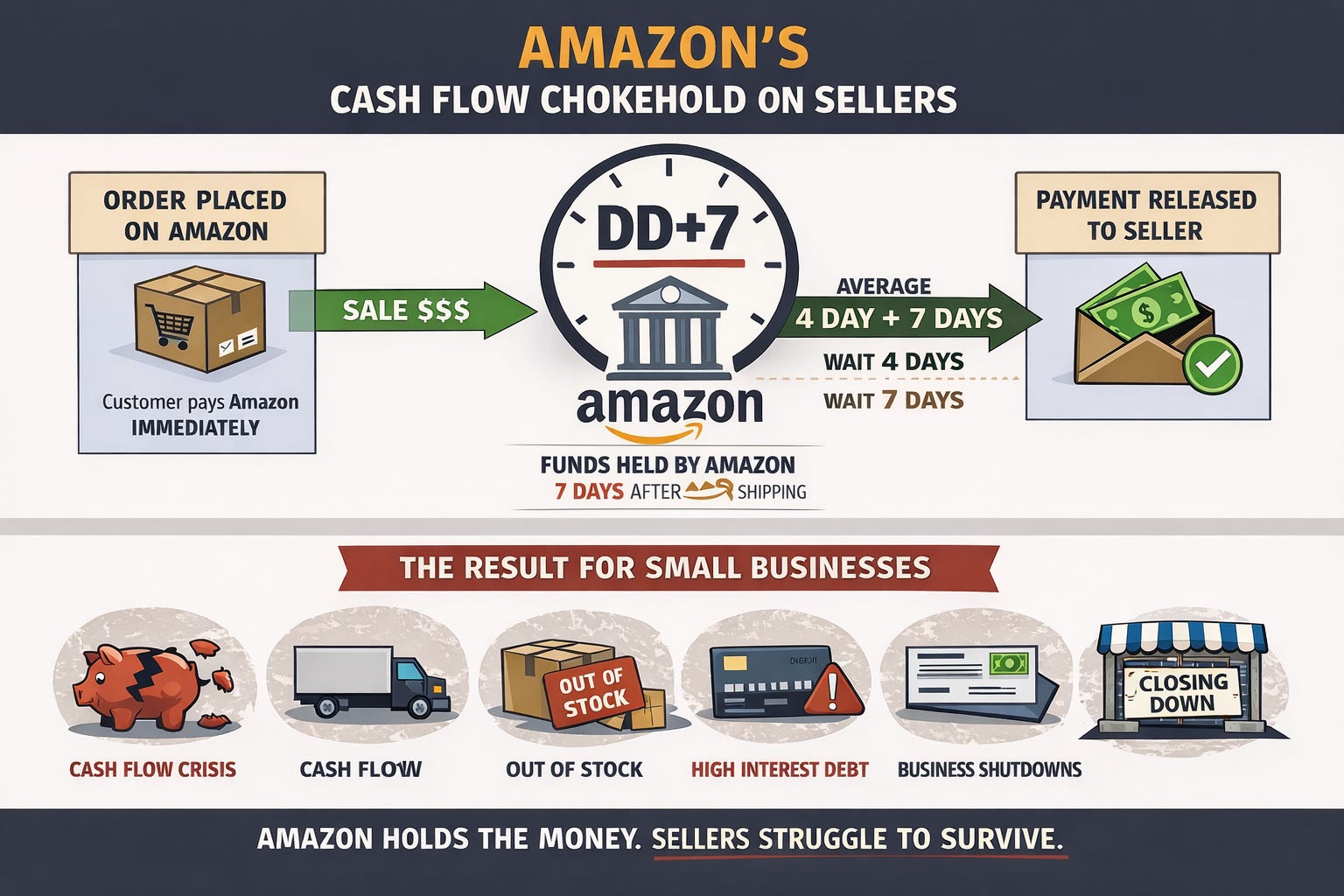
Under the policy, Amazon now holds seller funds until seven days after an order is delivered before releasing the money to the merchant who actually sold the product. To Amazon, this is framed as a fraud-prevention measure.
To thousands of small businesses, it looks like something else entirely:
A trillion-dollar corporation forcing independent merchants to bankroll its operations.
And as the policy detonates a cash-flow crisis across Amazon’s seller ecosystem, a more uncomfortable question is starting to surface:
Where the hell is the regulator tasked with stopping this?
The Policy That Turned Sellers Into Lenders
The mechanics of DD+7 are simple.
But that’s only half the story.
Amazon sellers are typically paid on two-week disbursement cycles. Before the policy change, that meant many sellers were already operating with roughly two weeks of revenue floating inside Amazon’s system before it was paid out.
Now add DD+7.
The result is that many sellers are effectively waiting three to four weeks from the time a customer pays for an order before the seller actually receives the revenue. During that entire period Amazon is holding the money.
Meanwhile, sellers must still pay immediately for:
inventory suppliers
shipping carriers
warehouse storage
payroll
advertising fees
Amazon marketplace fees
All before Amazon releases the money from the sale.
The result is a forced working-capital squeeze on businesses that already operate on narrow margins.
Industry coverage from outlets including Yahoo Finance and EcommerceBytes has warned the change could trigger severe liquidity problems for independent sellers, many of whom rely on fast payment cycles to restock inventory. For large corporations with access to credit markets, a one-week delay might be manageable.
For small businesses, it can be existential.
Amazon’s Billion-Dollar Float
What makes the policy particularly striking is the scale of the marketplace it applies to. More than 60% of products sold on Amazon come from third-party sellers.
That translates into hundreds of billions of dollars in annual transaction volume flowing through Amazon’s platform.
Under DD+7, Amazon now holds that money for an additional week.
Which raises an obvious financial question:
How much interest is Amazon effectively earning by sitting on that money?
Even conservative estimates suggest the float could represent billions of dollars in temporarily withheld seller revenue at any given moment.
Money that does not belong to Amazon.
Money that belongs to the small businesses that generated the sale.
Yet Amazon now controls it.
Sellers Are Already Sounding the Alarm
If regulators want to know how the policy is playing out in real life, they don’t need to commission a study.
They can read Amazon’s own forums.
Across dozens of threads on Amazon Seller Central, merchants describe the same pattern:
frozen operating cash
inability to restock inventory
reliance on high-interest credit
layoffs and business closures
The tone in those discussions is not subtle.
It’s panic.
Sellers are openly warning that the policy will force thousands of small businesses into insolvency. Yet Amazon representatives responding in those threads have largely framed the policy as a matter of “financial discipline.”
For merchants watching their revenue locked inside Amazon’s payment system, that explanation rings hollow. You cannot discipline your way out of a cash-flow chokehold imposed by the platform holding your money.
The Digital Robber Baron Economy
The DD+7 controversy exposes a deeper structural issue in modern platform capitalism.
Amazon’s marketplace has become essential infrastructure for online retail. Small businesses depend on it for access to customers. But that dependence gives Amazon extraordinary leverage over the businesses operating inside its ecosystem.
In the late 1800s, railroad magnates used similar leverage over farmers and merchants. Today, the rails are digital. And Amazon owns them.
Founder Jeff Bezos built one of the most powerful commercial infrastructures in history. But power on this scale raises a fundamental question:
Who ensures that power is not abused?
The Regulator That Forgot to Regulate
In the United States, that responsibility falls primarily to the Federal Trade Commission.
The FTC exists to prevent exactly this kind of market imbalance—where a dominant platform imposes terms that smaller businesses cannot realistically refuse. Yet despite years of mounting complaints from Amazon sellers, enforcement action addressing marketplace payment practices has been conspicuously absent.
The DD+7 rollout has only intensified the frustration.
Thousands of merchants are now openly asking the same question:
Why is a company allowed to hold billions in other people’s revenue without meaningful oversight?
When a bank holds customer deposits, regulators monitor the system carefully. When a trillion-dollar tech platform does something similar inside a marketplace ecosystem, the regulatory silence has been deafening.
The Warning Signs Are Already Visible
Economic pressure does not stay neatly confined to balance sheets. When people feel economically trapped, anger follows.
Recent reporting by ABC7 Los Angeles and the Los Angeles Times described an alleged arson attack at a warehouse in Ontario, California linked to labor grievances.
No one should condone violence. But incidents like this highlight what happens when workers and small businesses begin to feel the system is rigged against them. Policies that concentrate power and financial leverage in the hands of a few corporations while squeezing everyone else tend to create exactly that kind of resentment.
History has seen this movie before.
Amazon Needs to Pay Attention
Amazon’s marketplace is not a side business. It is the engine that drives the company’s retail dominance.
Without third-party sellers:
Amazon’s product catalog collapses
consumer choice shrinks dramatically
the platform loses the entrepreneurial ecosystem that made it powerful
Policies like DD+7 risk destroying the very businesses that built that ecosystem. The question now is whether Amazon leadership recognizes the danger. Or whether regulators will finally decide that the digital economy deserves the same scrutiny the railroad barons once faced.
Because if the answer to both questions remains “no,” the backlash is not going to disappear.
It’s going to grow.
Sources
Seller discussions on Amazon Seller Central regarding DD+7 implementation
Reporting by EcommerceBytes on seller liquidity concerns
Coverage by Yahoo Finance regarding financial strain among Amazon merchants
Ontario warehouse fire reporting by ABC7 Los Angeles and the Los Angeles Times