


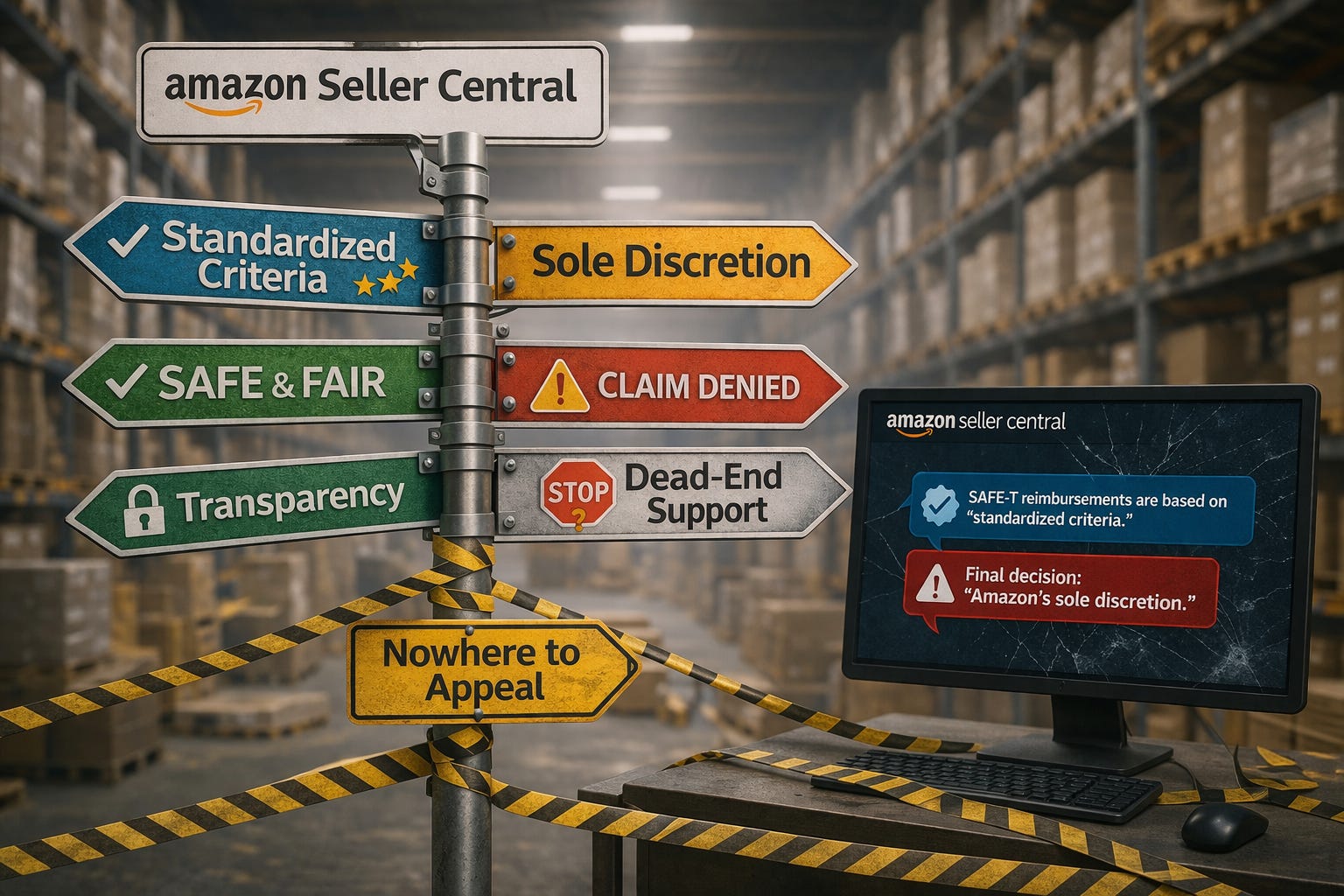
Amazon tells sellers its SAFE-T reimbursement system is based on “standardized criteria.” It also states those same decisions are made at its “sole discretion.”
When asked how those two claims can coexist—and how consistency is ensured—Amazon’s own support team provided a clear answer:
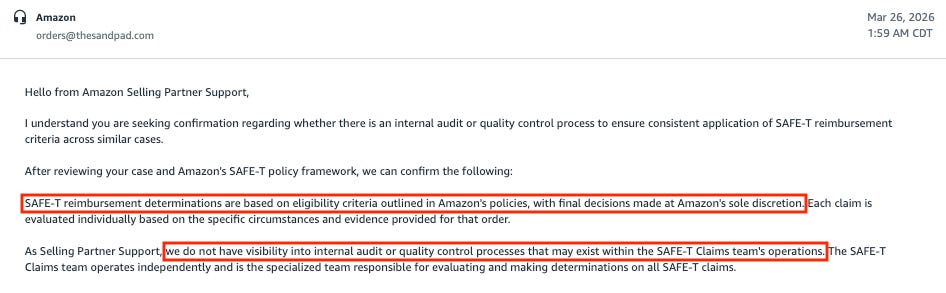
“SAFE-T reimbursement determinations are based on eligibility criteria outlined in Amazon’s policies, with final decisions made at Amazon’s sole discretion.”
But when pressed on how those criteria are applied or reviewed:
“We do not have visibility into internal audit or quality control processes that may exist within the SAFE-T Claims team’s operations.”
And when asked how sellers can verify consistency across similar cases:
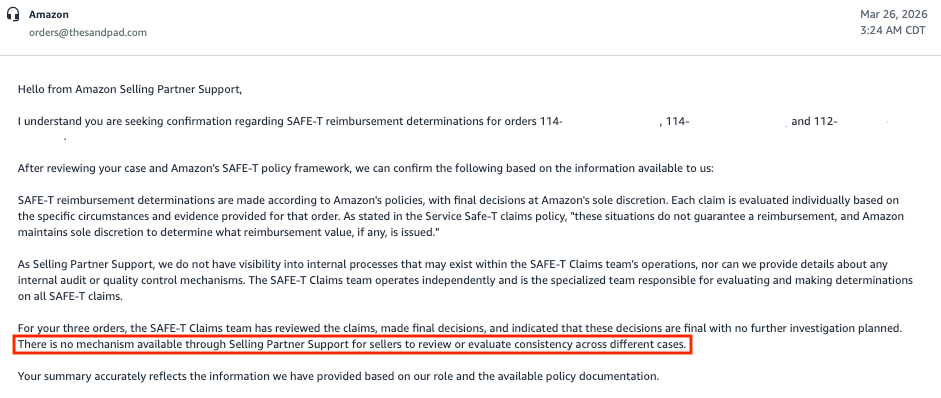
“There is no mechanism available through Selling Partner Support for sellers to review or evaluate consistency across different cases.”
In other words, sellers are told the system is standardized— while also being told there is no visibility into how those standards are applied, and no way to verify that they are applied consistently.
The Promise of SAFE-T
Amazon’s SAFE-T (Seller Assurance for Ecommerce Transactions) program is marketed as a safeguard—designed to reimburse sellers when they are charged for refunds that are not their fault.
In practice, however, sellers often absorb losses first, particularly under “Refund at First Scan” (RFS), where refunds are issued to customers before returned items are even inspected.
The expectation is simple: If a return is invalid, incomplete, or abusive, SAFE-T is supposed to make the seller whole.
But recent case records reviewed by Chicago Sentinels suggest something very different.
Similar Cases, Different Outcomes
Across multiple recent orders involving buyer-fault returns, used merchandise, and out-of-policy refunds, reimbursement outcomes varied dramatically—even where the underlying facts were materially similar.
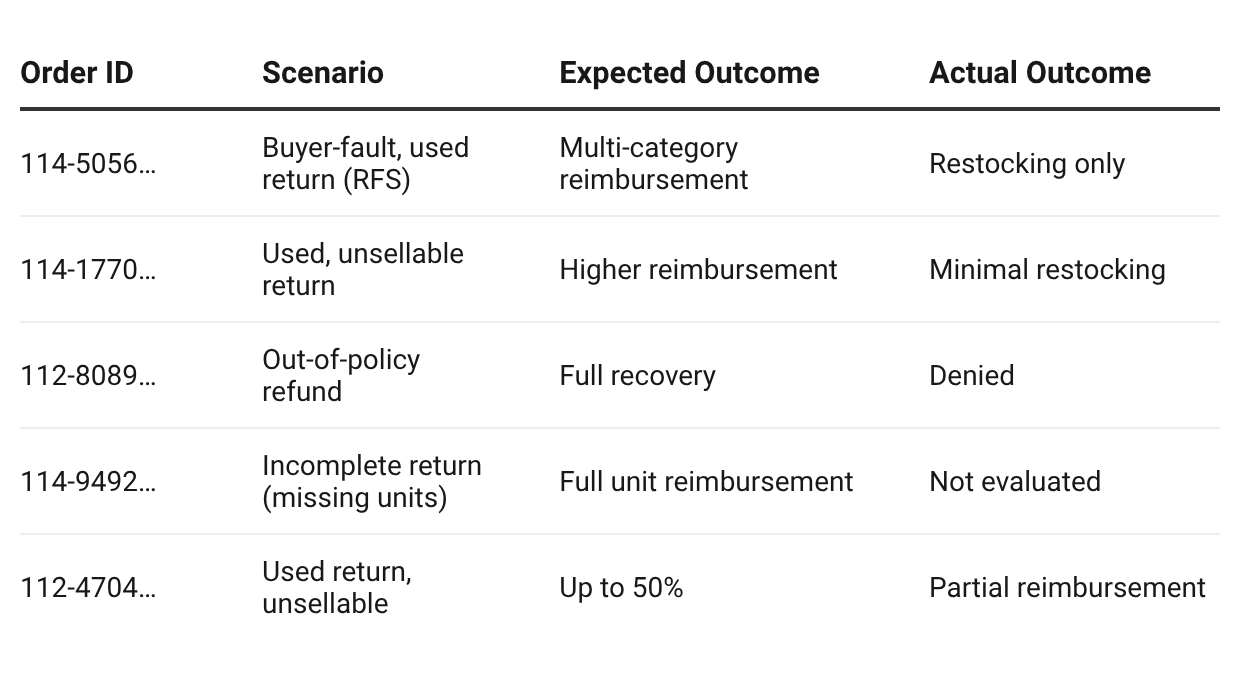
In some cases, only partial restocking fees were issued. In others, claims were denied entirely—even when key elements of the claim were not addressed.
A System No One Can Explain
When sellers attempted to clarify how these outcomes were determined, Amazon’s support responses revealed a deeper issue—not just inconsistency, but opacity.
At the same time, Amazon states that:
“SAFE-T reimbursement determinations are based on eligibility criteria outlined in Amazon’s policies, with final decisions made at Amazon’s sole discretion.”
However, when asked how those decisions are governed or reviewed internally, Amazon’s support team acknowledged:
“We do not have visibility into internal audit or quality control processes that may exist within the SAFE-T Claims team’s operations.”
And further confirmed:
“There is no mechanism available through Selling Partner Support for sellers to review or evaluate consistency across different cases.”
The Contradiction
Amazon’s position, taken at face value, is this:
Decisions are based on “standardized criteria”
The application of those criteria is discretionary
The criteria cannot be disclosed
The application cannot be explained
There is no visible mechanism to ensure consistency
These statements are not framed by Amazon as contradictory—but together, they describe a system that is effectively:
Non-transparent, non-reviewable, and discretionary in outcome.
The Closed Loop
The SAFE-T process offers sellers one appeal.
After that:
decisions are final
no further investigation is conducted
no escalation path is provided
no explanation is available beyond generic policy references
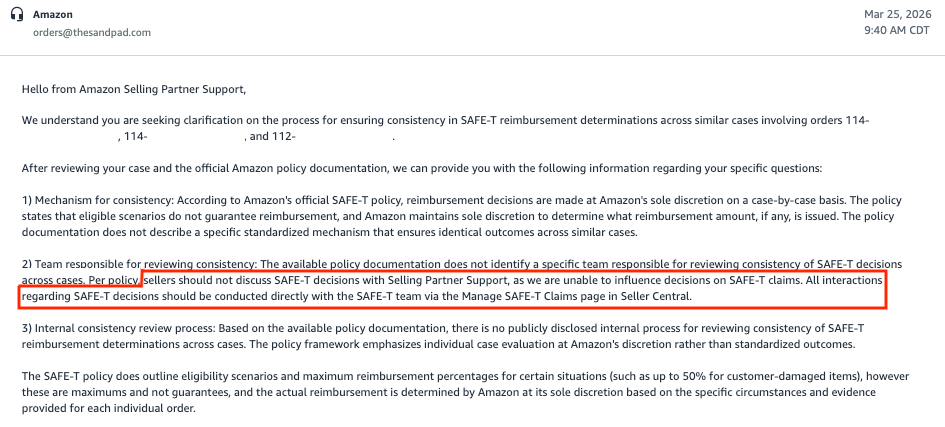
Even Amazon’s own support teams confirm they cannot intervene in SAFE-T outcomes:
“Sellers should not discuss SAFE-T decisions with Selling Partner Support, as we are unable to influence decisions on SAFE-T claims.”
At the same time, sellers are directed back into the SAFE-T system itself:
“All interactions regarding SAFE-T decisions should be conducted directly with the SAFE-T team via the Manage SAFE-T Claims page in Seller Central.”
A team that, by Amazon’s own admission, does not provide detailed explanations of its determinations.
Why This Matters
For independent sellers, these are not abstract concerns.
They translate directly into:
unrecoverable inventory losses
unreimbursed shipping costs
refunds issued without inspection
unpredictable financial outcomes
In cases involving used or incomplete returns, sellers may lose both the product and the revenue—without a clear explanation of why reimbursement was limited or denied.
The Bigger Question
Amazon describes SAFE-T as a system governed by standardized criteria.
It also states those decisions are made at its sole discretion.
At the same time, it acknowledges that sellers have no visibility into how those decisions are reviewed—and no mechanism to evaluate whether they are applied consistently across similar cases.
For sellers, that leaves a system that cannot be independently verified, cannot be meaningfully challenged, and cannot be clearly explained.
And when a system cannot explain how its decisions are made, the question is no longer about individual claims— then what protection does the system actually provide?
Ongoing Investigation
Chicago Sentinels is continuing to review additional SAFE-T outcomes across multiple sellers to determine whether these inconsistencies represent isolated incidents or a broader systemic pattern.
Sellers with similar experiences are encouraged to come forward.