


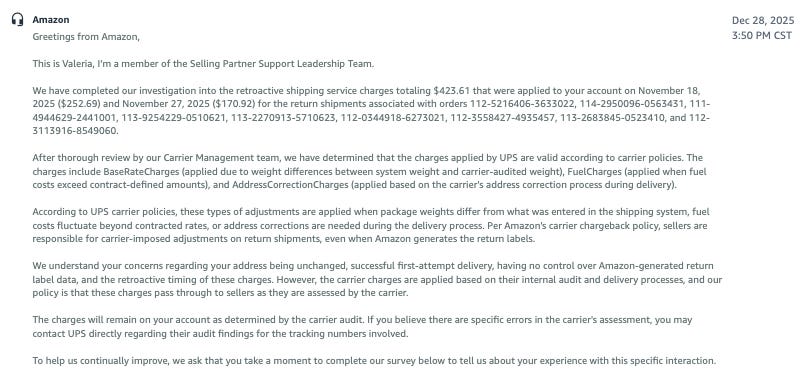
For months, Amazon marketplace sellers across the country have been reporting a quiet but costly problem: unexplained UPS “address correction” fees tied to Amazon return shipments — fees that Amazon then passes directly to sellers.
The addresses are valid.
The return labels are generated by Amazon.
Deliveries succeed without issue.
Yet sellers are still charged.
After repeated attempts to obtain clarity through Amazon’s seller support channels, one Chicago-based seller escalated the issue directly to UPS — and uncovered a practice that raises serious questions about transparency, accountability, and cost-shifting inside Amazon’s third-party marketplace.
What Sellers Are Experiencing
The pattern reported by multiple sellers is consistent:
A buyer initiates a return.
Amazon generates the UPS return label.
The return is shipped.
Days later, the seller sees a carrier “address correction” or “adjustment” fee of $28+.
Amazon passes the charge to the seller with little or no explanation.
In many cases, sellers are told their address was “incorrect,” despite years of successful deliveries to the same location.
What UPS Confirmed
After direct contact with UPS, the seller received confirmation that UPS maintains its own canonical address records for many buildings. If UPS believes a unit or suite exists for a given address, it may automatically insert that information during processing.
If the address printed on the shipping label does not already include the suite or unit that UPS has on record, UPS treats the change as an address correction and applies a fee.
That fee is billed to Amazon — and then passed through to the seller.
Critically:
Sellers cannot edit Amazon-generated return labels.
Amazon does not disclose how carrier-side address normalization works.
Sellers are not informed that UPS is modifying the address internally.
In the Chicago case, UPS confirmed it was adding “Suite 2” to Amazon return labels — even though deliveries to the building function normally without that designation.
A Systemic Transparency Problem
This issue is not about a single incorrect address. It reflects a broader structural gap involving three parties:
Amazon, which controls label generation but provides no guidance on carrier address standards.
UPS, which applies internal address rules without visibility to sellers.
Third-party sellers, who absorb the resulting fees without advance notice or a meaningful dispute process.
The outcome is a silent cost transfer that many sellers only notice after fees accumulate.
The Only Known Workaround
UPS advised that the only way to prevent the charges is for sellers to ensure that their Amazon return address exactly matches UPS’s internal address format, including any suite or unit number — even if it has never been required for delivery.
That requires sellers to:
Contact UPS directly.
Ask how UPS lists their address internally.
Update Amazon’s return address to match that record precisely.
Why This Matters
Amazon’s marketplace depends on hundreds of thousands of small and mid-sized sellers. Many operate on thin margins, where recurring carrier fees — especially unexplained ones — can materially affect viability.
More concerning is the lack of disclosure:
Sellers are not warned this can happen.
Amazon support offers inconsistent explanations.
Dispute mechanisms are poorly suited to address carrier-driven charges.
Several sellers report pursuing complaints through the Better Business Bureau and state regulators, citing non-response and lack of accountability.
The Larger Question
If sellers are expected to bear carrier adjustment costs, they should at minimum be told:
How those costs are triggered
When carrier systems override Amazon labels
How to prevent the charges before they occur
Absent that transparency, sellers are left to reverse-engineer a system they do not control — and pay for the privilege.